
The People’s History: The Continuum of Palestinian Resilience
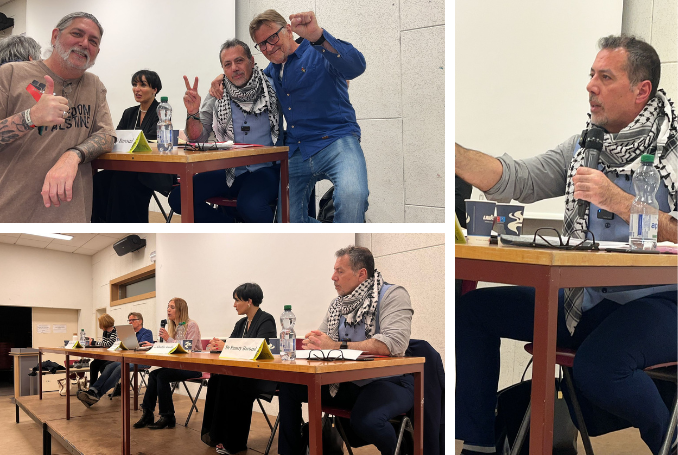
Dr. Ramzy Baroud during his address on the 78th anniversary of the Nakba, delivered in Geneva and Lyon, May 15–16, 2026. (Photos: Supplied)
These are the prepared remarks of Dr. Ramzy Baroud for his address on the 78th anniversary of the Nakba, delivered in Geneva and Lyon, May 15–16, 2026.
To understand the current moment in Gaza, one must first challenge the conventional way history is presented to us.
We are often taught to view history as a series of closed chapters—isolated events with clear beginnings and ends.
But history is not a museum; it is a living, breathing continuum.
The ‘Catastrophe’ of 1948—the Nakba—is not a relic of the past. It is an ongoing, stationary process.
When we look at the landscape of Gaza today, we are not witnessing a ‘new’ crisis or a sudden eruption of violence. We are witnessing the 78th year of a single, uninterrupted historical event.
To strip the present moment of this context is to engage in a form of intellectual erasure. History is the study of causality, and in the Palestinian context, that causality has never been broken.
The Micro-History of the ‘Un-Peopled’
The truth of a nation is rarely found in the proclamations of generals or the treaties signed in distant capitals. These ‘macro-histories’ are often designed to obscure the human pulse of a struggle.
Instead, the real history of Palestine is found in the micro-narratives: the stories of the peasant, the refugee, the student, and the mother.
This ‘People’s History’ functions as a counter-archive. While the official record may attempt to ‘un-people’ the land, the collective memory of the village provides an irrefutable rebuttal.
A grandmother’s recollection of the scent of her orange grove in 1948 is not just a personal memory; it is a historical document. It is a primary source that survives long after the physical village has been paved over.
By centering these ‘small’ stories, we discover that the most powerful historical force is not military might, but the persistence of the human spirit.
The Generational Relay: From 1948 to Gaza
This brings us to the process of becoming. We must see the Palestinian struggle as a generational relay, where the torch of memory and resistance is passed from one hand to the next without hesitation.
Consider the lineage of the struggle:
The generation of 1948, who carried their keys into the camps, turning exile into a permanent claim.
The generation of the late 20th century, who transformed the refugee identity from one of victimhood into one of political agency.
The youth in Gaza today, who are the direct descendants of that original displacement.
These are not separate groups of people; they are the same story told in different tenses. The young man standing amidst the rubble in Gaza is not a disconnected actor; he is the biological and political continuation of his grandfather’s journey from a stolen village.
When we understand this continuum, we realize that the Palestinian people are not merely ‘surviving’ history—they are writing it through their steadfastness, or Sumud.
Journalism as History in Real-Time
In this context, the role of journalism changes. It can no longer be a detached observation of ‘events.’ Journalism must become the documentation of the continuum. Reporting without historical depth is merely noise; it serves to confuse the public by presenting effects without causes.
The responsibility of the storyteller today is to practice Narrative Sovereignty. For decades, the Palestinian story has been translated and filtered through external lenses that prioritize the ‘security’ of the occupier over the humanity of the occupied.
True journalism in the Palestinian context must function as a real-time archive. Every interview conducted in a hospital, every testimony recorded from a destroyed neighborhood, is a stitch in the larger tapestry of the People’s History. We are not just reporting on a crisis; we are documenting the latest entry in a century-long ledger of resistance.
The People as the Subject
Ultimately, the goal of centering the people’s history is to remind the world that Palestinians are not the objects of history—they are the subjects. They are not passive victims to whom history ‘happens’; they are the actors who shape their own destiny despite the immense forces arrayed against them.
The fact that the Palestinian narrative remains vibrant and defiant after nearly eighty years of the ‘Catastrophe’ is the strongest signal of all. It proves that while land can be occupied and walls can be built, the continuum of a people’s identity cannot be severed.
History is an unfinished book. And as long as the stories of the ordinary people—the micro-histories of the brave—continue to be told, the final word will never belong to the oppressor. It will belong to those who refused to be forgotten.
The Nakba is a Structure, Not an Event
As I bring these thoughts to a close, I want to leave you with a fundamental shift in perspective. We must internalize the fact that the Nakba is a structure, not an event. If we view 1948 as a tragedy that simply ‘happened,’ we fall into the trap of ‘managing’ the aftermath. We start talking about ‘humanitarian corridors,’ ‘economic relief,’ or ‘conflict management.’
But when you recognize that the Nakba is the permanent architecture of the state—a machine built for dispossession—then every action we see today, from the genocide and siege of Gaza to the expansion of settlements, becomes legible. It is not a series of random ‘security’ decisions; it is the structural logic of Zionism in motion.
To address the ‘Palestinian problem’ without confronting the Zionist structure is like trying to fix a leaking tap while the foundation of the house is being demolished. We must stop managing the victims and start confronting the system.
The Reality of Palestinian Agency
Secondly, we must reject the narrative that portrays Palestinians as mere objects of history or passive recipients of aid. Throughout this speech, we have seen that the continuum of the struggle is maintained by Palestinian agency.
Agency is not just found in spectacular acts of resistance; it is found in the ‘Micro-history’ of daily life:
It is the teacher in Gaza holding classes in a tent; it is the farmer replanting an uprooted olive tree; it is the journalist who continues to broadcast while their own home is in ruins.
This is the proof that the Palestinian people are the primary actors in their own liberation. They are not waiting to be saved; they are insisting on their right to exist. When we speak of Palestine, we are not speaking of a ‘case’ to be solved, but of a nation that is actively shaping its own historical path against all odds.”
The Trap of the ‘Sub-Lecture’
Finally, we must dismantle the practice of ‘sub-lecturing’ or teaching the Palestinian people how they should exist or resist. There is a persistent, colonial habit of dividing Palestinians into ‘moderates’ and ‘extremists,’ ‘pragmatists’ and ‘radicals.’
We must be clear: these categories are not created for the benefit of the Palestinian struggle. They are created to serve the Zionist narrative.
When the international community demands that Palestinians adopt a specific ‘style’ of resistance that is palatable to their oppressors, they are participating in the erasure of Palestinian sovereignty.
By categorizing our people, they seek to divide the continuum we have discussed today. They want us to believe that the farmer’s struggle is different from the refugee’s struggle, or that the writer’s words are separate from the fighter’s resolve.
But as the People’s History shows us, it is one struggle. It is one people. It is one continuum. Our role is not to judge the Palestinian resistance or to refine it for Western consumption; our role is to honor its integrity and to recognize that the right to resist is not a privilege granted by the occupier, but a natural law born of the struggle for the land.”
Let us leave this room today not just with more information, but with a different lens. History is not behind us; it is beneath our feet. The path forward requires us to stop looking at Palestine through the eyes of the manager, and to start seeing it through the eyes of the people who have refused—for eighty years—to let the fire of 1948 go out.
Thank you.
0 Comments