
Publishers Weekly Highlights ‘Before the Flood’ as Record of Palestinian Historical Memory
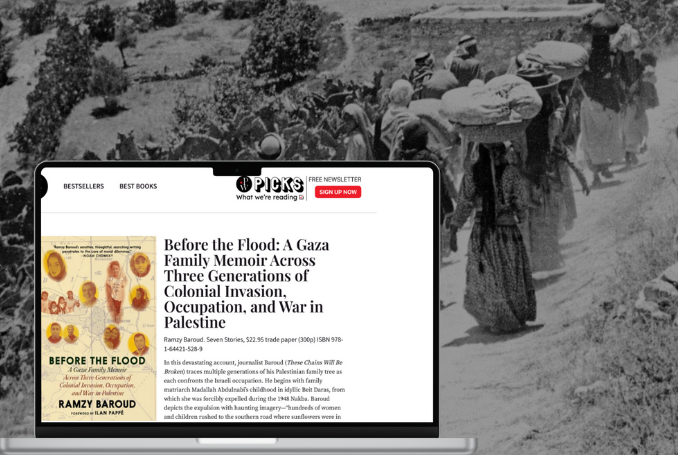
February review in Publishers Weekly has spotlighted Before the Flood by Palestinian journalist and historian Ramzy Baroud. (Design: Palestine Chronicle)
A February review in Publishers Weekly has spotlighted Before the Flood by Palestinian journalist and historian Ramzy Baroud, describing the book as an “indelible depiction of the generational trauma that defines the Palestinian struggle.”
The review places the work inside the mainstream American publishing landscape, marking an important moment in the book’s reception beyond political commentary and into the professional literary sphere.
Founded in 1872, Publishers Weekly is one of the publishing industry’s most influential trade journals. Read primarily by editors, agents, librarians, and booksellers, its reviews help guide purchasing, stocking, and translation decisions across the market.
A Family Story Rooted in the Nakba
In its February issue, Publishers Weekly framed Before the Flood as a multigenerational account anchored in the 1948 Nakba. The review opens with the story of family matriarch Madallah Abdulnabi, expelled from Beit Daras during the mass displacement of Palestinians, recalling “hundreds of women and children” fleeing toward “the southern road where sunflowers were in full bloom.”
It highlights Baroud’s ability to juxtapose beauty and violence, noting scenes of “two little sisters shot holding hands,” imagery that the journal says clarifies how the Nakba’s trauma continues to resonate across generations.
According to the review, the narrative traces “multiple generations of his Palestinian family tree as each confronts the Israeli occupation,” demonstrating that the Nakba is not a closed historical episode but an ongoing inheritance.
Gaza and the Al-Badrasawi Family
The review places particular emphasis on the Gaza branch of the family, especially Ehab al-Badrasawi, whose life trajectory forms the emotional center of the narrative.
It recounts his participation in the First Intifada as a “scrawny 11-year-old,” after “an Israeli had deliberately run over Palestinian[s]… waiting by a bus stop.” The later killing of his younger brother Wael reshaped his life, eventually leading him to join Hamas — a development the review presents as part of a chain of events shaped by violence and loss.
The narrative then follows younger relatives whose lives unfold under siege and culminate in the events of October 7 and Israel’s genocide. The book, the journal writes, “catalogs their experiences of imprisonment, torture, and loss,” creating the sense that Wael’s death had “sealed the fate… of the al-Badrasawi family.”
Rather than presenting political analysis alone, Publishers Weekly describes a story built from lived experience, portraying a family repeatedly pulled into history rather than choosing it.
A People’s History
Through one extended family, Before the Flood reconstructs Gaza’s history across decades of displacement, camp life, prison experience, and generational memory.
This approach reflects Baroud’s broader historical method: documenting Palestine through ordinary people rather than state actors.
The result functions simultaneously as memoir, testimony, and historical record, presenting Gaza not as a sudden crisis beginning in October 2023 but as part of a continuous historical trajectory beginning in 1948.
A Shift in Literary Reception
The Publishers Weekly review signals more than literary praise. Because the publication guides acquisition decisions across the publishing world, its recognition situates Before the Flood within the wider literary marketplace rather than a niche political category.
By calling the work an “indelible depiction” of generational trauma, the review points to a broader shift in reception: Palestinian testimony increasingly treated as literature documenting lived history, not solely as political commentary.
0 Comments